Control an OEM replacement mechanical seal cross-reference through identity, interface, duty, materials, deviations, first-article approval, and repeat-order records.
On this page

An OEM replacement seal cross-reference is a controlled equivalence decision, not a catalog-number substitution. Approve the replacement only after identity, critical interfaces, arrangement, materials, operating duty, installation setting, support connections, inspection, and deviations have been reviewed. Then freeze a repeat-order record so the next purchase does not restart from an unlabelled sample.
Separate identification from equivalence
Identification asks, “What is this seal?” Equivalence asks, “Which characteristics must the replacement preserve, and which differences are acceptable?” The first can often be supported by a code, drawing, pump model, photographs, or sample. The second requires a defined interchange boundary and approval authority.
Use the mechanical seal identification guide when the existing item is still unknown. Do not move directly from a visual match to an order if the pump, seal chamber, material suffix, or operating duty remains uncertain.
ISO 21049:2004 states that its sealing-system scope can apply to spare parts and upgrading existing equipment in covered services. Its categories, types, arrangements, orientations, data sheets, and purchasing requirements illustrate why a replacement needs more than a dimensional resemblance. This does not make an independently supplied replacement an OEM product or prove compliance with ISO 21049/API 682.
Establish the reference identity with independent sources
Create a source register instead of copying the first code found.
| Source | Information recovered | Reliability check |
|---|---|---|
| Pump nameplate, serial, and manual | Equipment model, build, shaft/chamber options | Confirm document applies to this serial or size |
| Original seal code or label | Manufacturer family, size, arrangement, material suffix | Preserve the complete code and code-system revision |
| Approved drawing | Nominal interfaces, setting, ports, materials | Confirm status, revision, and equipment tag |
| Maintenance/purchase record | What was previously installed or bought | A past purchase may repeat an error or field change |
| Unused verified spare | Physical construction and markings | Confirm storage identity and package label |
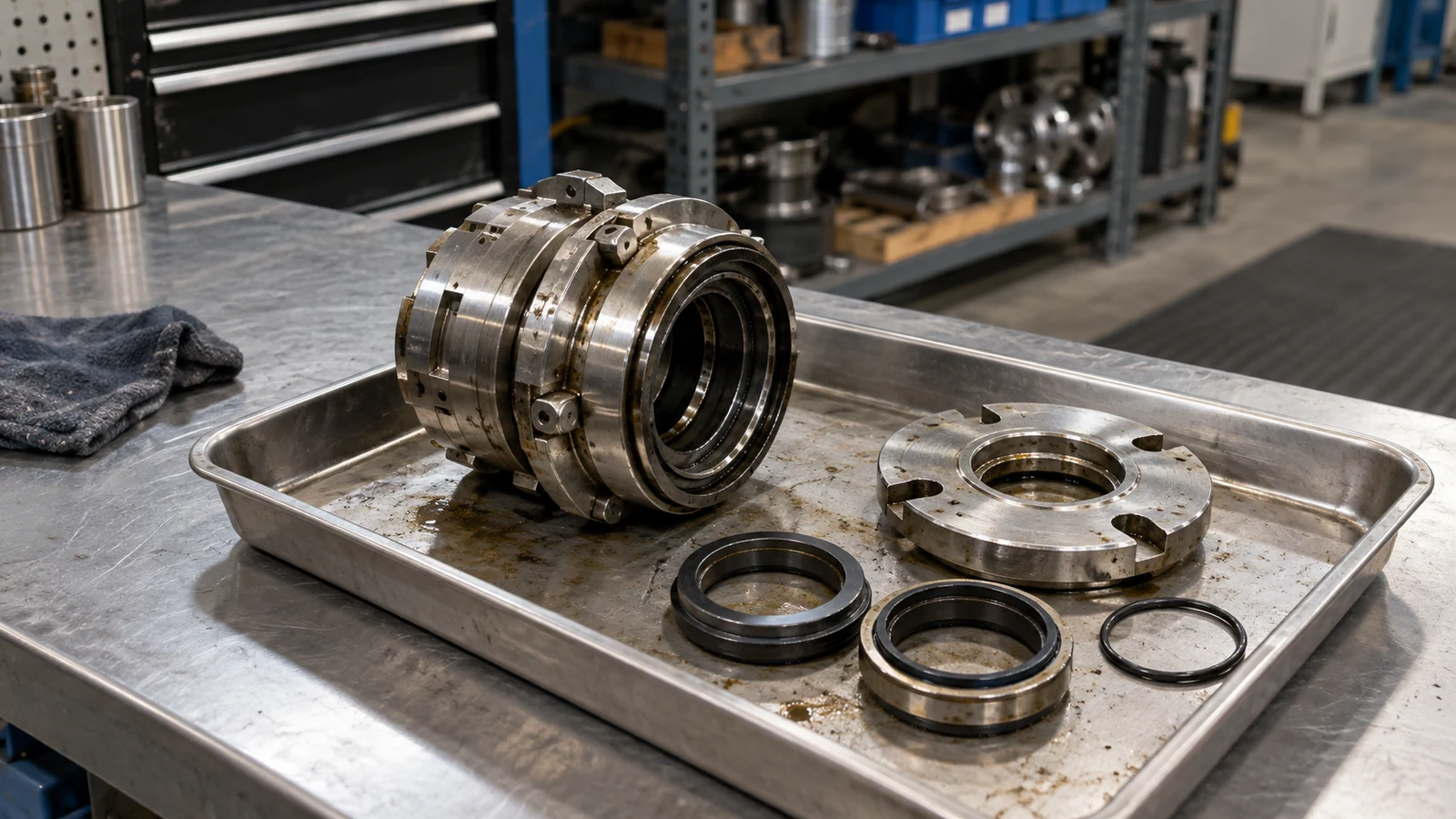
| Used sample | Installed geometry and visible wear/failure | Separate measured condition from intended nominal |
Require two independent sources for critical-to-fit values when the sample is damaged or the drawing is uncontrolled. If sources conflict, issue a technical query and identify which authority can resolve it.
Define the interchange boundary
List the features that must remain compatible with the installed equipment and maintenance procedure.
For component seals, the boundary can include shaft/sleeve diameter, rotating-unit bore and working length, stationary-seat fit and thickness, drive method, rotation, gland or housing interfaces, and face position.
For cartridge seals, add sleeve fit, gland register, bolt circle, gasket surface, axial envelope, drive-collar position, setting device, port size/function/orientation, hook or step geometry, and removal clearance.
For both formats, control:
- single or dual arrangement and orientation;
- balanced/unbalanced and pusher/bellows construction where relevant;
- face pair, secondary seals, metal parts, springs or bellows, and gaskets;
- pressure, temperature, speed, direction, and transient cycle;
- flush, quench, buffer, barrier, cooling, vent, and drain interfaces;
- allowable leakage direction and process contamination;
- installation tools, torque, setting, and commissioning steps.
The replacement does not have to reproduce every internal design feature if the supplier proposes a different engineered solution, but the difference must be visible, justified, and approved against the required duty and interfaces.
Reconfirm the current duty instead of copying the legacy material
An old seal may have been selected for a previous fluid, concentration, temperature, support plan, or operating schedule. It may also contain an undocumented repair material.
Provide the current fluid composition, normal and upset pressure/temperature, speed, solids, vapor behavior, operating cycle, cleaning media, support utilities, leakage objective, and recent failure evidence. Ask the supplier to state whether materials are copied from a verified record, identified from testing, or newly proposed for the current service.
Use the chemical pump seal selection guide when arrangement or material suitability is unresolved. Cross-reference is not a shortcut around application review.
Compare the proposed replacement in four gates
Identity gate
The equipment, original reference, sample ID, drawings, and revision history agree sufficiently to define the target. Conflicts are listed rather than hidden.
Interface gate
Critical dimensions, rotation, assembly setting, connection functions, and installation envelope are compared in a controlled report. Values recovered from wear or inference are flagged.
Duty and material gate
The current process and transient conditions have been reviewed against the proposed construction and complete material schedule. Product or catalog limits are not combined outside the supplier’s approved basis.
Approval gate
Drawings, deviations, first-article scope, tests, markings, instructions, packing, and change-control responsibility are agreed before repeat production.
| Gate result | Meaning | Purchasing action |
|---|---|---|
| Pass | Required evidence is complete and approved | Release the defined scope |
| Conditional | Open item has an owner and must close before a named milestone | Quote or prototype only; do not treat as production approval |
| Hold | Critical interface, duty, material, or authority is unresolved | Do not release the affected work |
| Reject | Proposed difference conflicts with a mandatory requirement | Revise the design or evaluate another option |
Use first-article approval to close uncertainty
First article is most valuable when it tests the actual uncertainties. A generic dimensional report may miss the stationary-seat fit, setting length, port orientation, drive engagement, or gasket contact that controls installation.
Define the approval evidence before manufacture:
- ballooned critical-interface drawing;
- dimension and method for each reported feature;
- proposed material verification and document type;
- assembly setting and free movement checks;
- leakage or pressure test where specified and appropriate;
- comparison to the reference sample without treating wear as nominal;
- installation trial, fit check, or site approval if required;
- disposition of any deviation before repeat supply.
The Hydraulic Institute mechanical-seal guide links selection, installation, maintenance, failure observation, and troubleshooting. That lifecycle view is important: a replacement that fits the bench but cannot be installed, supported, or monitored consistently is not a controlled equivalent.
Freeze a repeat-order master record
After approval, assign an internal replacement number that links to the equipment tag, original cross-reference, approved supplier number, drawing revision, material schedule, duty basis, inspection plan, test records, deviations, marking, packing, and installation instructions.
State what changes require reapproval, such as bellows alloy, elastomer compound, face grade, gland geometry, manufacturing location, critical process, inspection method, or support connection. Preserve the approved sample only when its storage and identity can be controlled.
Use the OEM-compatible replacement seal page to submit codes, drawings, samples, and duty data. Names and part numbers from other manufacturers should be used only to identify the requested reference; the proposed replacement must be described on its own controlled technical basis.
The workflow is complete when a future buyer can order the approved replacement without guessing which sample, suffix, drawing, material, or deviation was accepted.
Put the guide into practice
Related specification and RFQ pages
Frequently asked questions
Is matching an OEM seal code enough to approve a replacement?+
No. A code helps identify the reference, but approval should also control equipment interfaces, arrangement, materials, direction, setting, support connections, operating duty, inspection, and any deviation from the original supply.
Can a worn sample be used for cross-referencing?+
Yes, as one evidence source. Record wear, corrosion, compressed elastomers, broken features, and prior repairs, then corroborate critical dimensions with drawings, pump data, mating parts, or an unused verified spare.
What should be retained after a replacement seal is approved?+
Retain the approved drawing and revision, cross-reference sources, critical-interface report, material schedule, duty basis, accepted deviations, first-article results, markings, installation instructions, packing, and repeat-order part number.
Continue researching