Compare seal repair and replacement using recoverable components, testing, installed cost, usable spares, and the downtime that actually changes the decision.
On this page
A repair quotation at half the price of a new mechanical seal can be attractive. It becomes less attractive if the repair leaves the pump waiting for a critical component, retains a damaged fit, or returns the same design to a duty that has changed. Conversely, replacing an entire cartridge may add little value when the reusable hardware is sound and the wear parts can be restored to the required condition.
The useful comparison is the cost of returning the pump to dependable service, with the same operating duty and acceptance requirements on both sides.
When does repairing a mechanical seal make sense?
Repair is a reasonable candidate when the assembly is identifiable, its major hardware is recoverable, replacement wear parts are available, and the repaired unit can be inspected and tested against defined requirements. The time needed to establish those facts is part of the repair route.
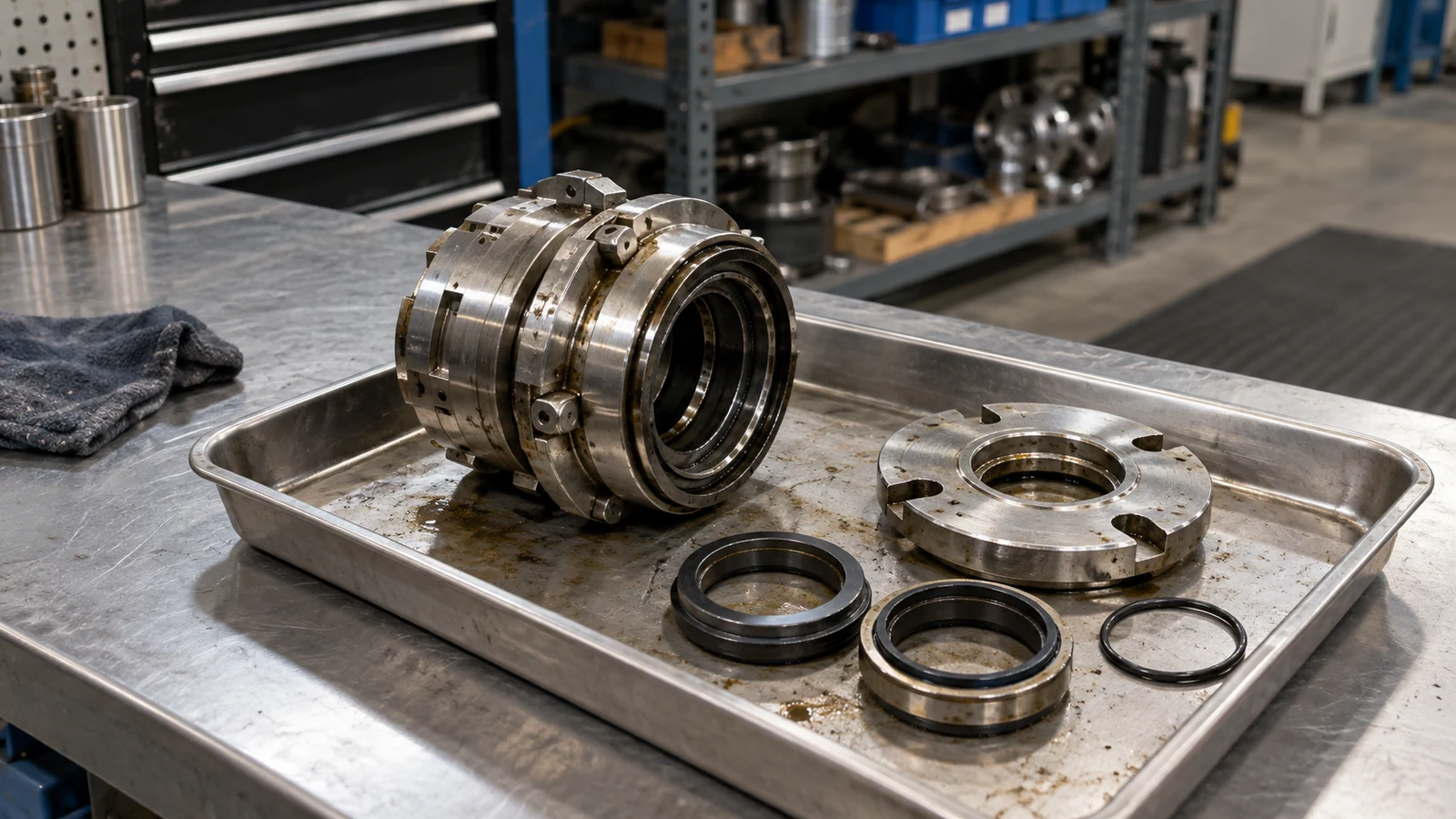
John Crane’s maintenance and repair description identifies disassembly, cleaning, inspection, and refurbishment as parts of wet-seal repair, including renewal of faces and secondary seals. That scope is broader than polishing a leaking face and reinstalling it.
The evaluation should distinguish three kinds of work:
- routine renewal of agreed wear parts;
- restoration of recoverable components to specified geometry and condition;
- replacement of components whose damage or dimensional loss exceeds the repair basis.
Those categories affect price certainty. A budget estimate before disassembly is useful for planning, while a firm repair scope normally follows inspection. A quotation that separates the inspection charge from the authorized repair cost makes the decision easier if the assembly proves uneconomic to recover.
What can make replacement the better route?
Replacement becomes more attractive when the major components are badly damaged, the seal’s identity or configuration cannot be resolved economically, or the duty requires a different design. It can also win when a compatible new assembly is available sooner and that time difference affects production.
Damage to a sleeve fit, distorted hardware, or extensive corrosion can expand a simple wear-parts repair into a larger rebuilding exercise. The important number is then the revised price after inspection, including the work needed to restore interfaces, rather than the first advertised repair price.
A change in liquid, temperature, operating speed, or support system deserves a separate application decision. Buying an exact copy of the failed unit and repairing the old unit both preserve the existing configuration. Neither option, by itself, addresses a duty mismatch. Use the OEM replacement cross-reference guide to distinguish dimensional compatibility from application suitability.
Build the comparison around a common scope
The two quotations should return equivalent deliverables: the required arrangement, face pair, secondary seals, critical dimensions, installation information, identification, and acceptance tests. A lower price can otherwise reflect a smaller scope rather than a more economical route.
| Cost or deliverable | Repair route | Replacement route |
|---|---|---|
| Initial assessment | Disassembly and recoverability decision | Identity, fit, and duty confirmation |
| Components | Renewal and restoration list | Complete supplied assembly and any reused items |
| Verification | Dimensional and agreed functional checks after repair | Agreed checks for the new assembly |
| Installation | Removal, fitting, alignment, and commissioning | Same activities, plus any conversion work |
| Logistics | Outbound and return transport, cleaning requirements | Incoming transport and possible import handling |
| Stock after completion | Repaired unit installed or retained as spare | New unit installed, old unit possibly recoverable |
Test language needs enough detail to identify what will be delivered. A static leakage test and a dynamic running test answer different questions. Specify the relevant medium, conditions, acceptance criteria, and report for the purchased scope rather than using “fully tested” as a substitute.
A worked installed-cost comparison
Consider an illustrative cartridge seal that can be repaired without changing the pump. The same crew and installation work are required for either option. All values below are assumptions for the example, not supplier prices.
| Item | Repair | New replacement |
|---|---|---|
| Seal work or purchase | $1,200 | $2,600 |
| Removal, installation, and commissioning | $900 | $900 |
| Logistics | $150 | $100 |
| Total before additional production loss | $2,250 | $3,600 |
The repair advantage is $1,350. If choosing repair causes three additional hours of lost production valued by the plant at $450 per hour, that advantage disappears:
Break-even extra downtime = $1,350 ÷ $450/h = 3 hours
This is a sensitivity calculation, not a prediction that the repaired seal will fail sooner. Any difference in expected service life needs a defensible basis, such as the actual repair scope and relevant service history. Without that basis, show a range of downtime scenarios instead of assigning an arbitrary failure probability.
Count only the waiting time that affects operation
A ten-day repair turnaround does not necessarily mean ten days of production loss. If an approved spare is installed immediately, the pump may return to service while the failed unit is repaired for stock. If the pump is already scheduled to remain shut down for other work, some repair time may also have no additional production effect.
The opposite can happen with a nominally quick replacement. Delivery to the warehouse may precede dimensional confirmation, installation hardware, or commissioning readiness. Compare the date each route makes the pump available for operation.
Separate production loss from maintenance labor already included in the table. Use the plant’s incremental economic loss for the affected hours rather than total sales revenue, and avoid counting the same consequence twice.
For a fleet with repeatable seal configurations, a rotating spare can turn repair and replacement into complementary decisions: buy a new unit when necessary to restore coverage, then recover the removed assembly when its condition justifies the work. The purchase decision then improves both today’s return to service and the stock available for the next intervention.
Put the guide into practice
Related specification and RFQ pages
Frequently asked questions
Should a failed seal be discarded after a replacement is ordered?+
Retain it until the failure assessment and possible repair evaluation are complete. A recoverable assembly may become a service spare, and the removed parts can help explain why the failure occurred. Follow the site's decontamination and storage procedure.
Is an exchange seal directly comparable with a repair quotation?+
Compare the exchange unit's specification and test scope, core-return deadline, deposit, and charges for a rejected core. Those terms can change both the final cost and the stock available after the job.
Continue researching