Prioritize pump spares by failure consequence, replenishment time, interchangeability, and repair options, with a worked reorder-point and usable-stock example.
On this page
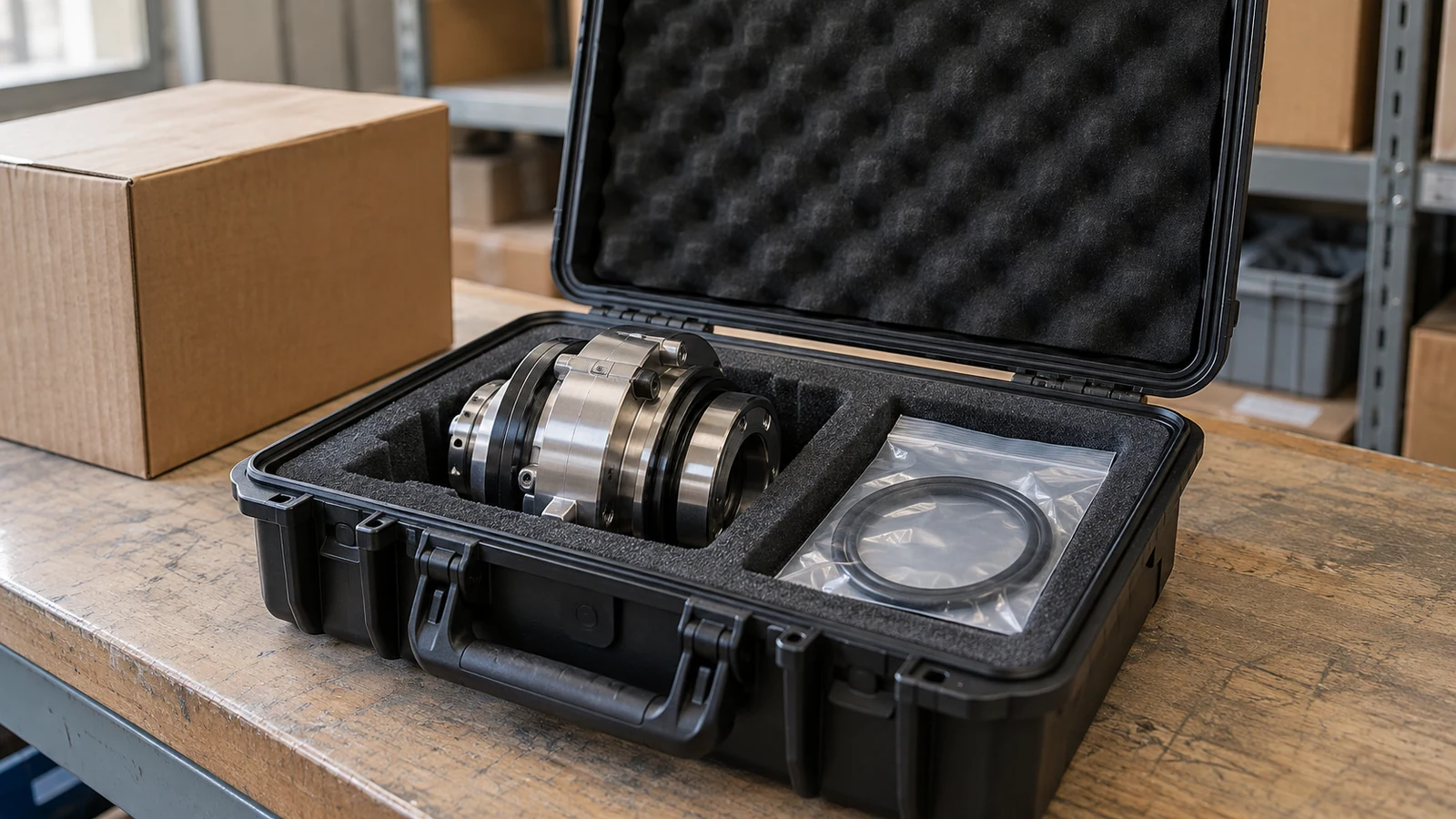
A spare-parts store can contain many pump components and still lack the one assembly needed to restart a critical service. The opposite problem is familiar too: expensive parts sit unused while readily available items consume shelf space and purchasing effort.
The useful organizing principle is recovery time. Decide which failures require an immediately usable spare, which can be covered by a standby pump, and which allow enough time for a planned purchase or repair. Then set stock around those differences.
Which pump spares deserve priority?
Prioritize parts whose absence would cause a serious operating consequence and whose replacement time exceeds the time the plant can tolerate. Purchase price and annual issue frequency are useful inputs, but neither measures criticality by itself.
KSB’s spare-parts guidance describes the balance between capital tied up in stock and the risk of unplanned downtime. It also emphasizes identifying parts through equipment-specific information. Those two ideas belong together: the stock must be both worth holding and correct for the installed equipment.
| Recovery situation | Likely stock approach |
|---|---|
| Critical service with no effective standby | Evaluate an installation-ready assembly and the parts needed to complete the job |
| Duty/standby pair with proven changeover | Compare repair or purchase time with the period the site accepts reduced redundancy |
| Several pumps with a truly interchangeable part | Pool stock using the combined demand and exposure |
| Standard item with dependable local supply | Consider lower stock if procurement time fits the recovery window |
| Obsolete or long-lead custom part | Preserve the design data and assess a dedicated spare or manufacturing plan |
A standby pump reduces exposure only if it is available, suitable for the required duty, and capable of being put into service. Its existence on an equipment list is not the same as operating coverage.
Count usable stock separately from repair candidates
The stock record should distinguish an accepted spare, a part allocated to a planned job, a confirmed incoming order, and a failed assembly awaiting inspection. They have different availability.
A basic inventory-position calculation is:
Inventory position = usable on-hand stock + confirmed incoming supply − allocated or backordered demand
Suppose the store has two accepted seal cartridges, one confirmed incoming unit, and one cartridge allocated to an upcoming shutdown. The inventory position is two units: 2 + 1 − 1 = 2.
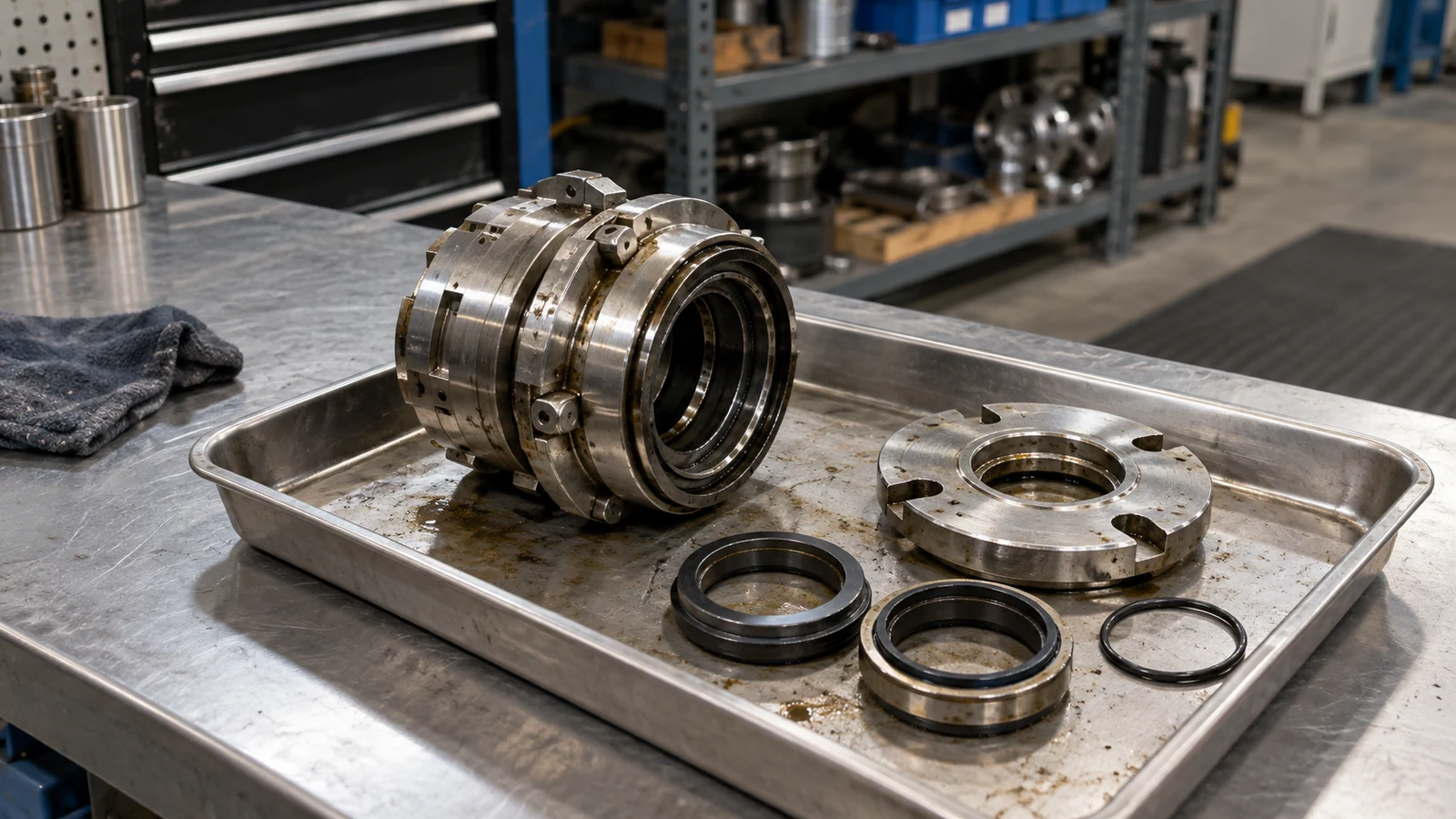
A failed cartridge on the repair shelf does not become a third usable unit simply because it may be recoverable. Track its inspection status and expected return separately. Once the repair scope, completion date, and acceptance are sufficiently established for the site’s planning rules, it can enter the incoming-supply record.
Keep revision and material information with the stock code. A cartridge that fits physically but uses a face pair or elastomer unsuitable for the current duty is not an interchangeable spare for that service.
A simple reorder-point example
For reasonably repeatable demand, a starting reorder point is expected demand during replenishment lead time plus a chosen safety allowance. It is a planning model; the service consequence and demand variability determine whether it is adequate.
Assume a verified interchangeable seal family is issued six times per year, replenishment takes 12 weeks, and the plant chooses a safety allowance of two units for this example.
Expected lead-time demand = 6 × 12 ÷ 52 ≈ 1.38 units
Reorder point = 1.38 + 2 = 3.38, rounded up to 4 units
Under a continuous-review policy, an inventory position at or below four triggers replenishment. The earlier position of two would therefore require action. Order quantity is a separate decision; the reorder point does not mean automatically buying four units each time.
The chosen two-unit allowance has not been calculated to deliver a particular service level. A statistical policy needs the demand distribution, lead-time variation, review period, and target service measure. For rare but consequential failures, a consequence-based spare decision can be more useful than averaging a few historical issues.
Use the complete replenishment time
A supplier’s manufacturing lead time is only one part of the interval before a spare becomes usable. Identification, technical clarification, purchase release, transport, customs handling where applicable, receiving inspection, and any assembly work may add time.
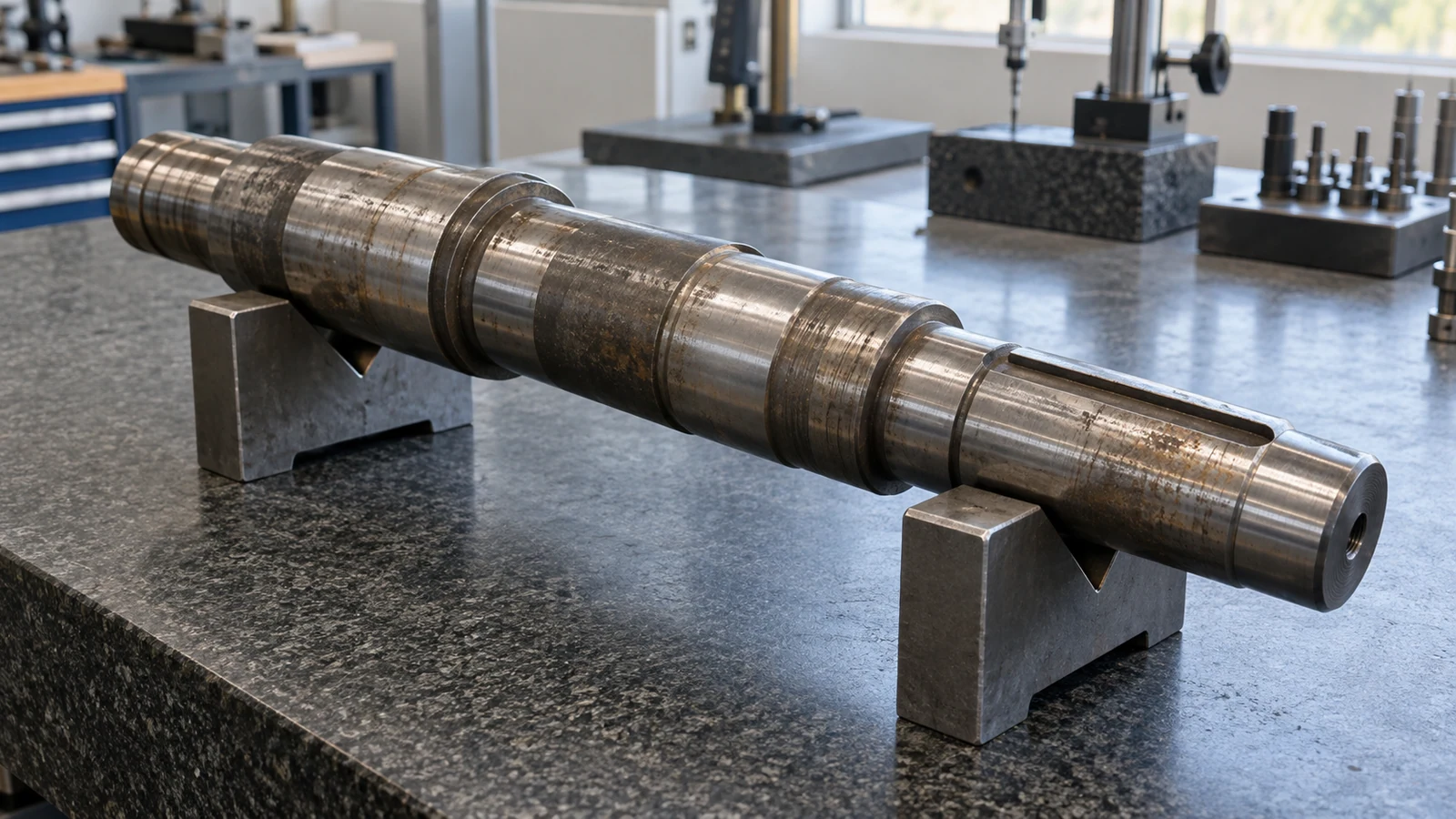
For a custom shaft or casting, unresolved drawing information can dominate the early part of that interval. The reverse-engineering guide describes how to convert an obsolete sample into controlled manufacturing data before the next urgent failure.
Use actual order histories to distinguish typical time from a credible longer case. A reorder policy based on a best-case shipment can leave the plant exposed when one inspection or material supply step takes longer.
Planned shutdown demand should be reserved explicitly. Otherwise, the inventory system may show enough stock for ordinary failures while maintenance has already committed those parts to scheduled work.
A rotating repair spare can improve coverage
For repairable seal cartridges, the fleet can operate a cycle: install an accepted spare, evaluate the removed assembly, repair it where justified, and return it to stock after acceptance. That can reduce dependence on a new assembly for every intervention.
The economics depend on recoverability, repair time, and the full work scope. The repair-versus-replacement comparison shows how installation and actual production loss affect that decision.
Repair coverage also needs a fallback for assemblies rejected after inspection. A pool whose entire replenishment plan assumes every removed seal will be recoverable can become depleted unexpectedly. Record repair yield and turnaround over time so the policy reflects what actually comes back.
Keep the stock policy tied to the installed fleet
Review the list when pump duty, seal configuration, equipment population, or supplier lead time changes. Consolidation is useful where interchangeability is established; retired equipment is a reason to reconsider its dedicated spares.
The final purchasing list should identify the equipment covered, exact part configuration, minimum usable quantity, replenishment trigger, and the route for repair or replacement. That gives procurement a reason for each stocked item and gives maintenance a realistic answer to the question that matters: how quickly can this pump return to service?
Put the guide into practice
Related specification and RFQ pages
Frequently asked questions
Should an unused spare be assumed ready to install?+
Verify identity, revision, completeness, preservation, and storage condition. Elastomers, exposed surfaces, packaging, and any manufacturer storage requirements need attention before a long-stored assembly is counted as installation-ready.
Can two pump models share a mechanical seal spare?+
Only when the dimensional interfaces, arrangement, materials, duty, and installation requirements are compatible. A common shaft diameter or similar appearance is not enough to establish interchangeability.
Continue researching