Combine vibration, temperature, leakage, and seal-support data to plan maintenance, specify monitoring, and buy the right spare before a pump intervention.
On this page
A rising vibration trend can create time to plan an intervention. It does not, on its own, identify a mechanical seal as the part to replace. Bearing condition, alignment, hydraulic operation, structural response, and seal-support behavior can all influence what the pump is doing.
The useful role of condition monitoring is to connect a change in behavior with an investigation and a maintenance action. For seal-related decisions, that usually means combining machine measurements with leakage observations and the conditions immediately around the seal.
What can pump condition monitoring tell you about a seal?
Monitoring can reveal changes associated with a deteriorating operating environment or developing equipment problem. It becomes more useful for seal maintenance when vibration and temperature are evaluated alongside leakage, chamber conditions, and support-system data. A trend is a reason to investigate; diagnosis comes from the combined evidence.
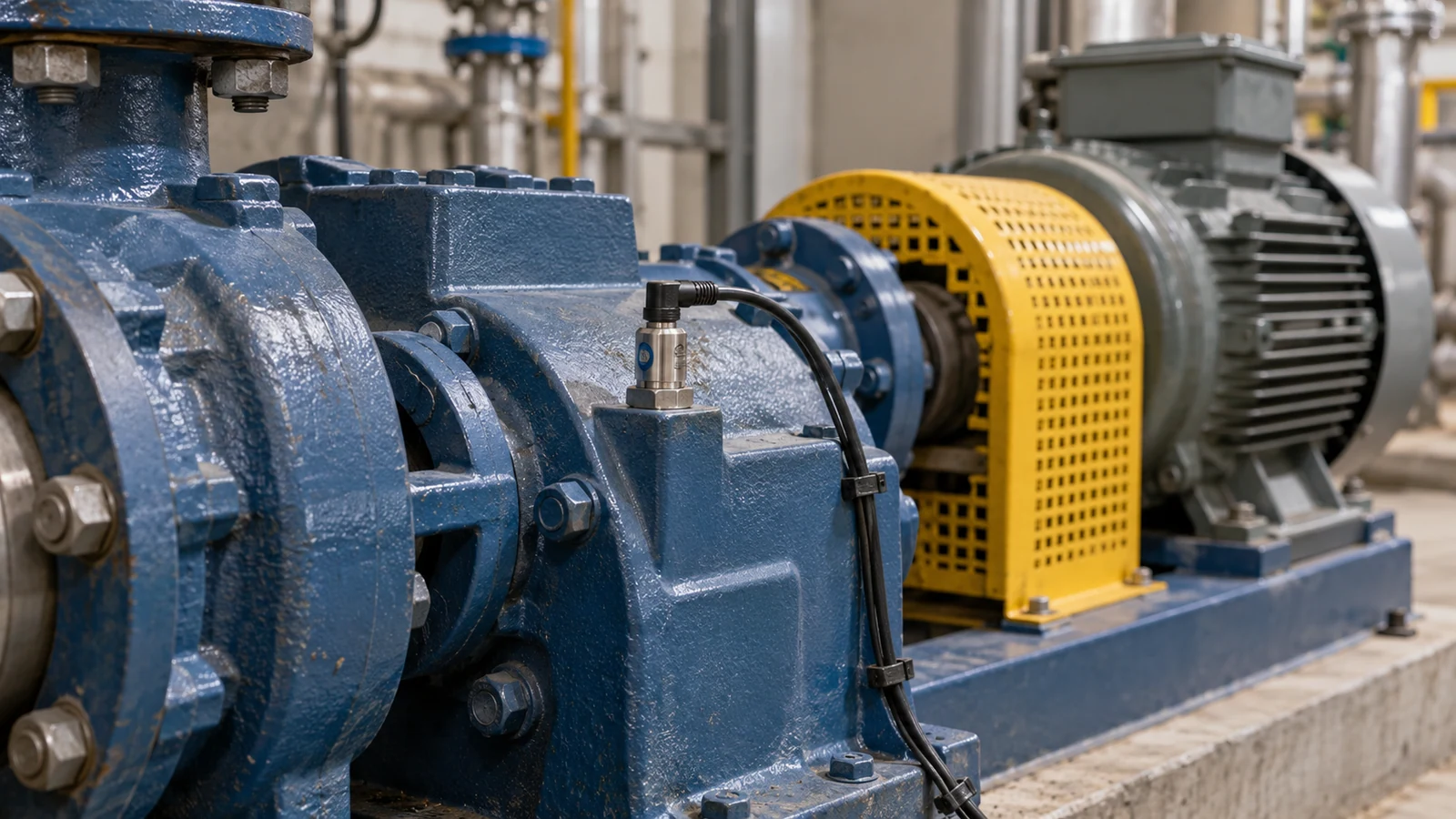
KSB’s account of predictive maintenance for pumps describes using vibration and temperature measurements with specialist interpretation to recommend maintenance. It illustrates the connection between sensing and action. It does not establish that a generic sensor can measure remaining seal life directly.
For a mechanically sealed pump, the relevant measurements may be distributed across the pump, driver, and seal system. Their value increases when timestamps and operating states can be compared.
Give each signal a defined job
An equipment-level vibration measurement and a seal-system pressure measurement answer different questions. Their alarm logic should reflect those roles.
| Signal | Useful interpretation | Additional context |
|---|---|---|
| Vibration trend | A change in mechanical or hydraulic behavior | Speed, flow, sensor mounting, frequency information, and baseline |
| Bearing or casing temperature | A changing thermal condition at the measured location | Ambient temperature, process temperature, load, and sensor position |
| Visible or collected seal leakage | A change in sealing behavior | Liquid identity, operating state, drain destination, and leak location |
| Barrier or buffer level | Changing liquid inventory | Refills, temperature, normal consumption, and possible process ingress |
| Seal-support pressure | Whether the intended pressure relationship is maintained | Chamber pressure and the relevant running or transient state |
| Flush flow or return temperature | Whether the support circuit behaves as expected | Supply conditions, restrictions, heat load, and instrument condition |
A falling barrier level could reflect normal consumption, an external leak, or increased leakage across a seal. A rising buffer level could reflect process ingress or a recorded refill. The distinction comes from the rest of the event history.
Compare like operating states
A pump at reduced speed and a pump at full production are not identical measurement conditions. The normal baseline should include the speed and process range in which the equipment operates. Otherwise, a load change can look like deterioration, or deterioration can be obscured by a change in duty.
Start with an asset record that links the measurement points to the pump tag, seal configuration, support plan, and current operating duty. Record changes to the seal, coupling, alignment, or sensor mounting. Those events can legitimately change the baseline.
For a variable-duty installation, trend comparable states or use an interpretation method that accounts for operating condition. The monitoring supplier should explain how those conditions are separated. More frequent data does not compensate for comparing incompatible states.
Time alignment is especially useful during a transient. If support pressure drops before leakage increases, the sequence suggests a different investigation from leakage beginning while support conditions remain stable. It helps identify what happened first without claiming that timing alone proves a cause.
From an alert to a specific maintenance task
An actionable workflow has a short chain: detect the change, verify the measurement, compare the operating context, identify the likely problem, and select the intervention. Each step should have an owner and a response appropriate to the process consequence.
Consider a hypothetical pump whose vibration rises after a change in production rate, while seal leakage and support conditions remain stable. The first investigation may focus on the changed hydraulic operating point and machine condition. Ordering a seal immediately could leave the cause untouched.
Now consider a falling barrier pressure differential accompanied by increasing barrier consumption. That combination directs attention toward the support system, pressure source, external leakage, and the seal arrangement. It provides a more specific maintenance question than a pump-wide vibration alert alone.
When a seal is removed, link the findings back to the event history. The failure evidence guide covers photographs, orientation, and service details. The additional value of monitoring is the sequence leading up to that physical evidence.
Buy a response process along with the sensors
A monitoring quotation should define the measurement range, acquisition interval, stored data, communications, and interpretation service. It also needs to say who receives alerts, who evaluates them, and how a maintenance recommendation reaches the site team.
For industrial installations, access to raw or appropriately detailed trend data matters. A dashboard status alone can be insufficient when the site wants to compare a pump event with process or seal-support records. Define data export, timestamp handling, retention, and the behavior during communications loss.
The plant’s existing protection system remains a separate scope. Advisory condition monitoring can improve maintenance planning without serving as the control that protects a hazardous process. Where the project requires a protective function, that function needs its own specified instrumentation and control design.
Match the warning window to the spare-parts plan
Early detection has practical value only if the required intervention can be organized in time. Compare the time available for investigation and maintenance with the availability of a compatible seal, required labor, and a suitable shutdown window.
If a spare takes longer to obtain than the credible warning window, monitoring may improve scheduling while still leaving a reason to hold stock. If a compatible rotating spare is already available, the same alert may allow replacement during a planned stop and repair of the removed unit afterward.
Use the alert history to improve the maintenance plan: which measurements led to a useful intervention, which needed more context, and which spare was actually required. That feedback turns digital monitoring into a procurement advantage—a better-defined part, ordered or stocked for a specific maintenance need.
Put the guide into practice
Related specification and RFQ pages
Frequently asked questions
Should a condition-monitoring alarm automatically stop the pump?+
An advisory monitoring alarm and a protective trip serve different functions. Automatic shutdown requires the appropriate equipment, defined process response, and site control design. A general monitoring service should not be treated as a protective system without that engineering scope.
Can historical readings be compared after a sensor is moved?+
Sensor location, orientation, mounting, and measurement settings affect the result. Record the change and establish a comparable baseline before interpreting the new readings as continuation of the old trend.