Choose slurry-pump seal faces by abrasion, impact, chemical exposure, lubrication, and material grade, including the role of carbide binders and face pairing.
On this page
The hardest seal face is not always the best choice for a slurry pump. Sliding abrasion, intermittent particle impact, chemical attack, and loss of lubrication damage a seal in different ways. Silicon carbide and tungsten carbide address those demands differently, and the grade within each family can matter as much as the family name.
For a replacement purchase, specify the rotary and stationary faces together. A quotation that says only “carbide faces” leaves both the material and the running pair open to interpretation.
Which carbide is better for abrasive slurry?
Silicon carbide is often a strong candidate where abrasion and chemical resistance dominate. Tungsten carbide deserves consideration where mechanical impact and demanding physical loads are prominent. The final choice depends on the exact grades, face pairing, slurry characteristics, and lubrication available in the seal chamber.
Vulcan Seals’ material guidance distinguishes silicon carbide’s wear and chemical properties from tungsten carbide’s resistance to particulate impact. It also describes nickel-bound tungsten carbide grades and the importance of choosing a running pair. That is a more useful basis for comparison than treating both materials as interchangeable hard rings.
| Duty feature | What it changes in face selection |
|---|---|
| Fine particles circulating continuously | Abrasive wear resistance and the ability to maintain a lubricating film |
| Large or irregular particles reaching the chamber | Impact exposure, edge damage, and the need to control solids at the seal |
| Corrosive liquid carrying solids | Resistance of the complete material grade, including secondary phases or binder |
| Frequent stops with settling | Restart friction, deposits, and how the chamber clears before rotation |
| Low-viscosity or hot liquid | Film stability, heat removal, and the face pair’s tribological behavior |
| Intermittent gas entrainment | Lubrication continuity and operating conditions beyond material hardness |
Particle concentration alone cannot describe these differences. A modest solids concentration with sharp, large particles can present a different problem from a dense suspension of fine particles.
Grade names carry the important details
“SiC” covers several engineered materials. Sintered, reaction-bonded, graphite-containing, and deliberately porous grades are offered for different chemical and lubrication conditions. They should remain separate entries in the material schedule.
Vulcan Seals’ comparison of silicon carbide grades describes both sintered and reaction-bonded options, along with porous and graphite-containing grades intended to modify lubrication behavior. The practical procurement lesson is to retain the supplier’s exact material designation and its application basis when comparing offers. An abbreviated material code from an old drawing may need to be translated before it becomes a current specification.
Tungsten carbide also needs a grade designation. The binder is part of the material exposed to the liquid, so the fluid’s compatibility with a generic carbide name is an incomplete assessment. A quotation should identify the binder system and the intended rotary/stationary combination, together with any operating restrictions that affect the duty.
For a chemical slurry, this grade-level review sits alongside the process compatibility assessment. It includes the liquid phase, cleaning chemicals, and occasional process changes, not just the abrasive solid.
Compare the pair and the chamber as one system
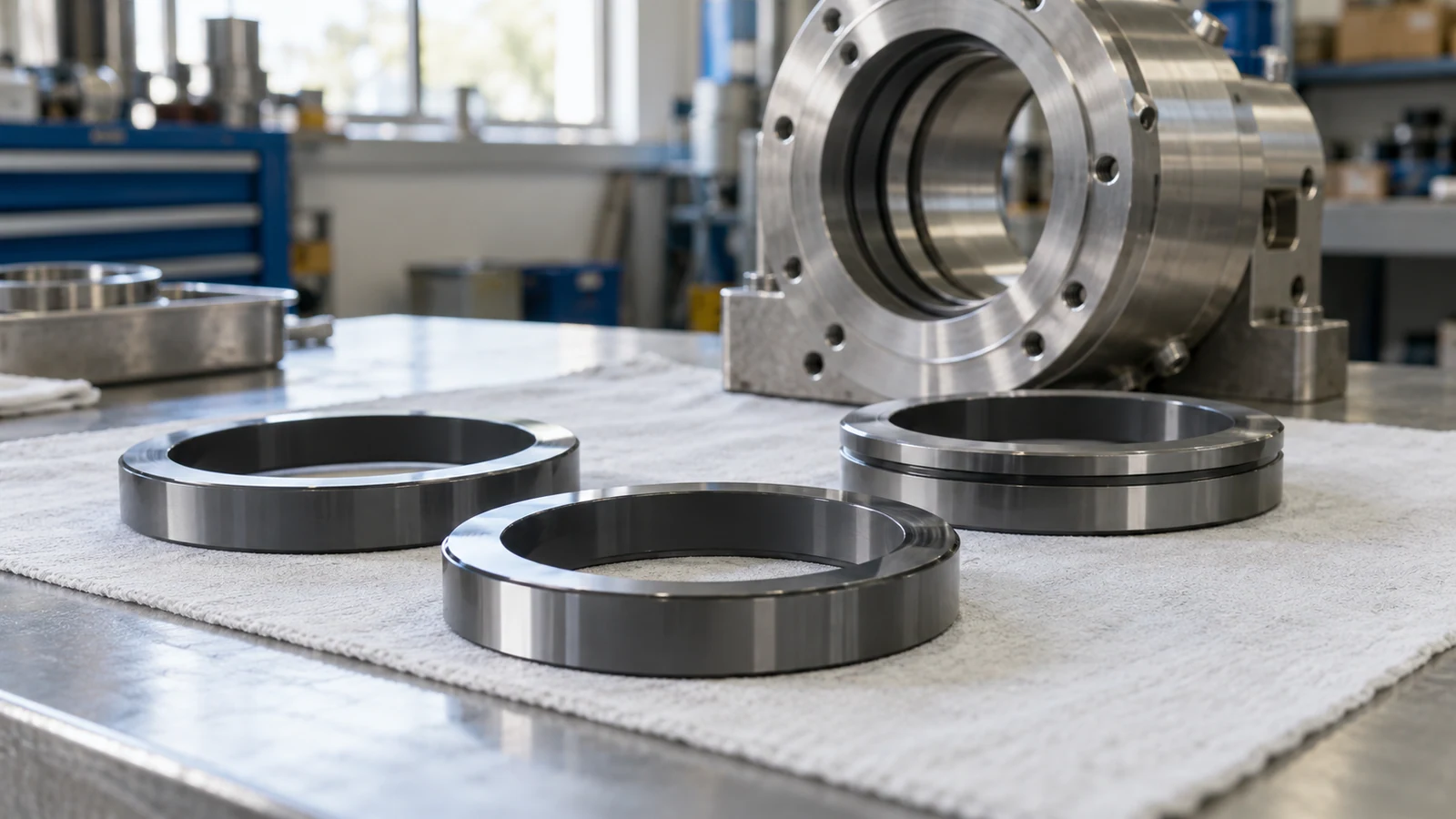
A mechanical seal runs two faces against each other across a thin fluid film. Changing one face affects friction, heat generation, wear behavior, and interaction with the mating face. Selecting two very hard materials does not remove the need for liquid at that interface.
In a clean, lubricating duty, a carbon/hard-face pair may be a sensible starting point. In an abrasive service, hard/hard combinations often enter the comparison because particles can damage a softer face. The appropriate choice still depends on the actual seal design and the fluid reaching it. A hard/hard pair working in a clean barrier liquid is a different application from the same pair exposed directly to slurry.
This is why the flush or barrier arrangement belongs on the same quotation as the face materials. A material upgrade may reduce abrasive wear, while a chamber or support-system change may reduce how much abrasive material reaches the faces in the first place. Compare those mechanisms separately so their costs and expected benefits remain visible.
For mining and heavy-equipment applications, also distinguish wear at a pump impeller or casing from wear at a precision sealing interface. A successful bulk wear material does not automatically become a suitable seal-face material.
Read the damage before changing the material
The removed faces can narrow the investigation. Broad wear tracks, chipped edges, deposits, and thermal damage suggest different questions, although no single mark uniquely identifies a cause.
A chipped ring after a difficult restart may direct attention toward settled solids, assembly contact, or an operating transient. A smooth but deeply worn track may justify closer examination of abrasive ingress and the face pair. Deposits that hold faces apart can make a chemically compatible and highly wear-resistant material leak.
Preserve the orientation and service history when sending parts for evaluation. The seal failure evidence guide covers how to retain that information. Here the purpose is narrower: connect the proposed material change to the observed failure mechanism instead of buying a more expensive grade without a clear reason.
Make the purchase specification unambiguous
A useful face-material line names the rotary grade, stationary grade, manufacturer or recognized designation, and the agreed pairing. Attach the slurry description: liquid chemistry, particle size range, solids concentration and its basis, operating temperature, chamber pressure, speed, and start/stop pattern.
Where past wear is the driver, include photographs and measurements of the removed faces and explain whether the proposed supply keeps the existing chamber and support arrangement. This lets two quotations be compared on the same operating assumptions.
The final comparison should show what each option is expected to improve. One may offer better chemical suitability; another may address impact exposure; a third may change the fluid environment around the faces. A buyer can then weigh the material premium against the particular failure mechanism, installation compatibility, and replacement availability. That is a firmer decision than choosing silicon carbide or tungsten carbide by name alone.
Put the guide into practice
Related specification and RFQ pages
Frequently asked questions
Does a hard face pair allow a slurry pump seal to run dry?+
A hard face pair still needs the lubrication and cooling specified for the seal design. Grades intended to improve marginal-lubrication behavior have specific limits; hardness alone does not establish a dry-running capability.
Can the seal faces be upgraded while retaining the existing elastomers?+
Only if the elastomers remain suitable for the process, flush liquid, cleaning chemicals, and full temperature range. A face-material change does not resolve swelling, hardening, or chemical attack in secondary seals.
Continue researching